Crows have long been a subject of fascination in various cultures, mythologies, and artistic representations. Their striking black feathers, sharp beaks, and eerie caws make them appear both ominous and intriguing. When paired with the symbol of a skull, the crow’s presence takes on an even deeper meaning, weaving together themes of death, transformation, and the unknown. In this blog, we’ll explore the symbolism and significance of a crow sitting on a skull.
The Crow: A Messenger of the Underworld
Throughout history, crows have been associated with death and the afterlife. In many cultures, these intelligent birds are seen as messengers or guides between the world of the living and the world of the dead. For instance, in Norse mythology, the god Odin is often accompanied by two ravens—cousins of the crow—named Huginn (thought) and Muninn (memory). These ravens are said to fly across the world, gathering knowledge and returning to Odin with valuable information.
Similarly, in Native American folklore, crows are seen as tricksters and keepers of secrets, bridging the gap between the physical and spiritual realms. Their association with death, however, is often balanced by their role as intermediaries, offering a sense of transformation and renewal.
The Skull: A Reminder of Mortality
The skull, on the other hand, is universally recognized as a symbol of mortality. It serves as a reminder of the inevitable cycle of life and death. Skulls have appeared in various artworks, rituals, and literature as a representation of human vulnerability and the transient nature of life. In some cultures, skulls are used to honor ancestors and the spirits of the deceased, as seen in the Mexican Day of the Dead celebrations.
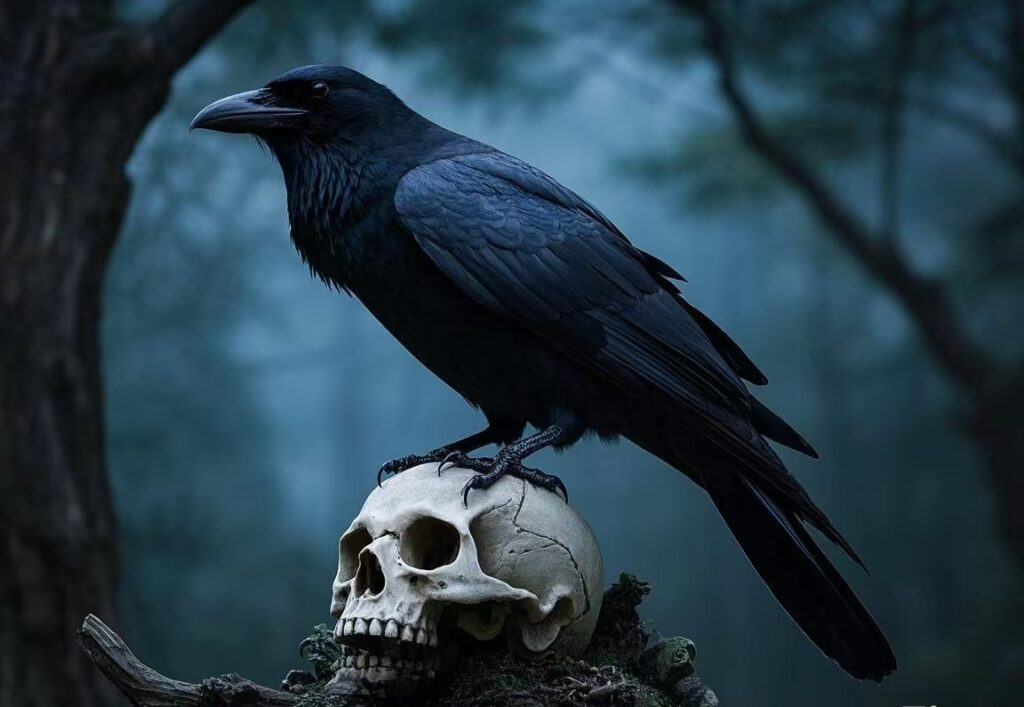
When combined with the crow, the skull adds another layer of meaning to the scene. It suggests that the crow, as a symbol of death, sits atop the remnants of life, acting as both a sentinel and a guide through the process of change and rebirth. The skull’s presence emphasizes the fleeting nature of existence, while the crow’s watchful gaze hints at the mysteries that lie beyond the grave.
Death and Rebirth: A Symbol of Transformation
Together, the crow perched on the skull becomes a powerful symbol of death, but also transformation and renewal. This imagery conveys the idea that death is not an end, but rather a transition. In many cultures, death is viewed as a doorway to the next stage of existence, whether that be reincarnation, the afterlife, or spiritual enlightenment.
The crow’s dark presence atop the skull can be seen as a harbinger of change—reminding us that life and death are interconnected, and one often leads to the other. The crow’s ability to fly freely between worlds reinforces this idea of movement and transformation. It’s not a symbol of finality, but rather of the ongoing cycle of existence.
Crow and Skull in Art and Popular Culture
In art, the image of a crow sitting on a skull is often used to evoke themes of mystery and the macabre. It’s a compelling visual that speaks to our primal understanding of mortality and the unknown. This motif has appeared in gothic literature, paintings, tattoos, and even modern film and television, often symbolizing a confrontation with death or the exploration of life’s darker aspects.
Edgar Allan Poe’s famous poem, The Raven, for example, captures the crow’s association with mourning and the supernatural. Although Poe’s raven is not perched on a skull, the image of the raven knocking on the door of the narrator’s mind is a powerful metaphor for confronting the inevitability of death and loss.
Conclusion: Embracing the Mystery
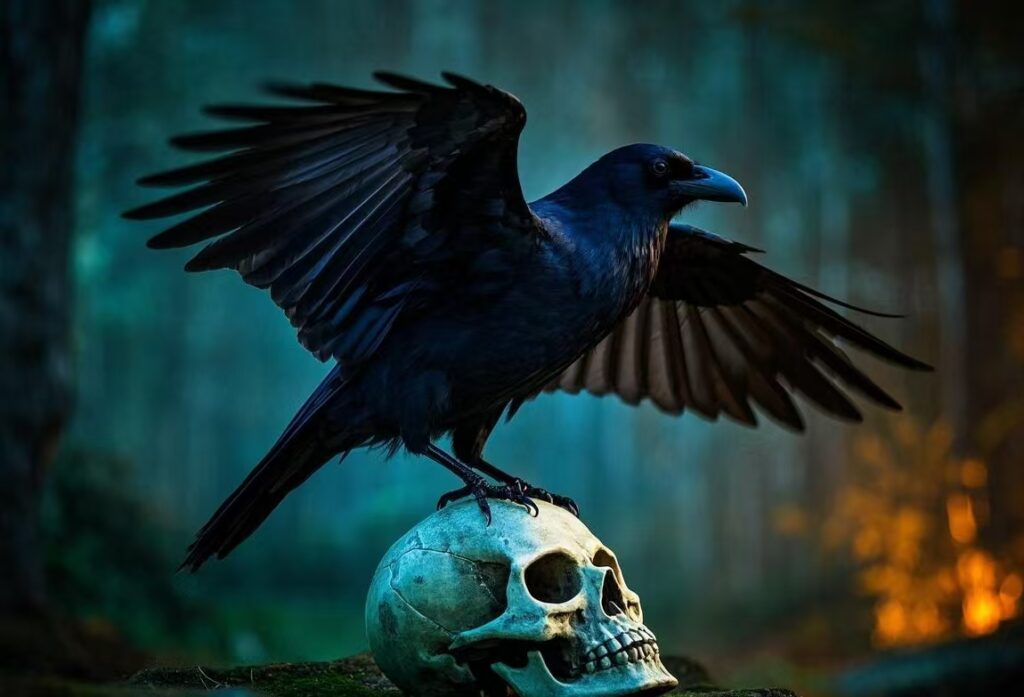
A crow sitting on a skull offers a powerful reminder of life’s fragile nature and the mysteries that await us beyond the veil of death. It speaks to the darker side of existence, yet it also offers a sense of transformation and renewal. Whether you encounter this image in a piece of artwork, a dream, or a cultural ritual, it invites you to contemplate your own relationship with mortality and the eternal cycle of life and death.
In the end, the crow on the skull serves as a reminder to embrace the unknown, to live fully in the present, and to remember that death is not something to fear, but a part of the great transformation we all experience.